
Migration to S/4HANA for EWM: Embedded or Decentralized, Which One Is Right for You?

Warehouse operations are at the heart of any supply chain. For companies still running SAP SCM or older releases of SAP EWM, the question is no longer if you should move to S/4HANA, but how.
The migration decision is strategic, and one of the most critical choices you will face is between Embedded EWM and Decentralized EWM on S/4HANA.
Both options offer powerful functionality and SAP’s long-term support, but they cater to very different business scenarios. Let us explore these deployment paths, weigh the pros and cons, and guide you toward making the best choice for your warehouse operations.
Why Migration Cannot Wait
SAP’s announcement to sunset ECC support by 2027 (with extended support to 2030) has triggered a wave of S/4HANA adoption. But for EWM customers, the impact is even more direct:
- SAP SCM 9.x and earlier releases will eventually lose mainstream maintenance.
- Integration layers like CIF (Core Interface) used to synchronize data with ECC are being phased out.
- New warehouse technologies such as robotics, AGVs, and AI-based forecasting integrate far more seamlessly in an S/4HANA landscape.
In short, if your warehouse is growth-driven, waiting too long means higher migration risk and missed opportunities for efficiency.
Deployment Options in S/4HANA: Embedded vs. Decentralized
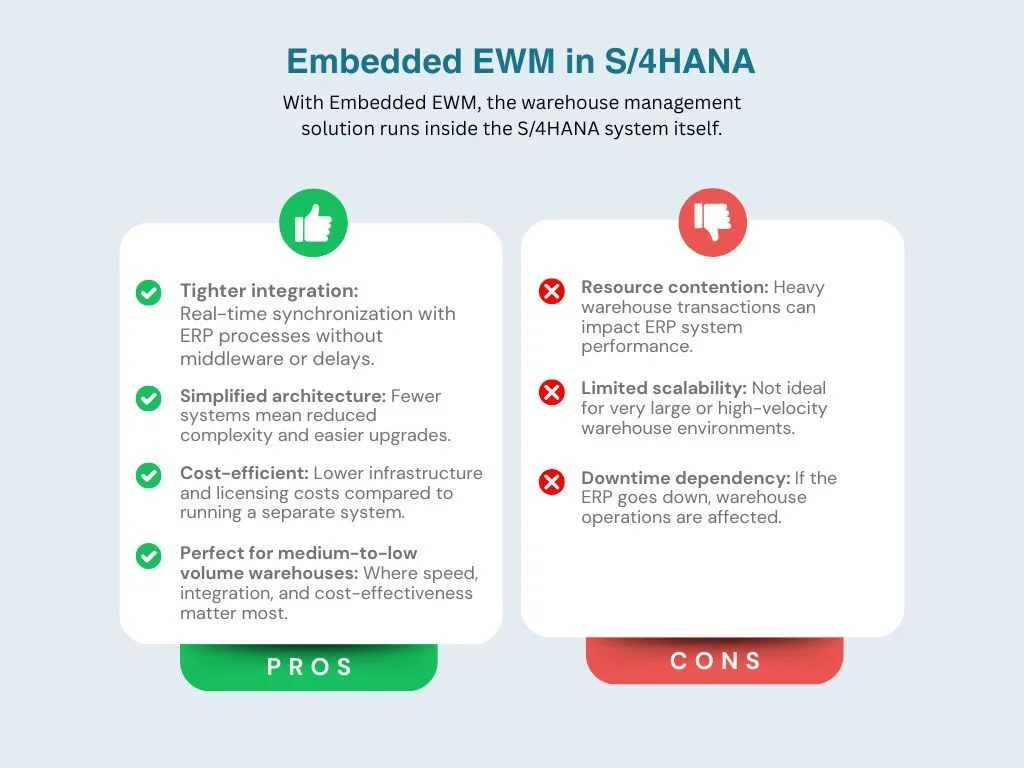

Migration Pathways for Existing Customers
For organizations running SAP SCM-based decentralized EWM, the move to S/4HANA can follow two main paths:
- Migrate to Embedded EWM
- Suitable if your warehouse volume is moderate.
- Ideal for businesses looking for tighter ERP integration and cost optimization.
- Works best when you want a simplified system landscape.
- Migrate to Decentralized EWM on S/4HANA
- Recommended for large enterprises with global distribution networks, automation, and 24×7 operations.
- Offers resilience, fault isolation, and scalability.
- Allows future flexibility as SAP continues to enhance advanced EWM features.
Key Considerations Before You Decide
- Business Scale & Volume: Are your warehouse operations moderate or high-volume?
- Automation Needs: Do you rely heavily on robotics or advanced automation?
- Downtime Tolerance: Can your business risk downtime if ERP and EWM are in the same system?
- IT Resources & Budget: Do you prefer a leaner system landscape or can you manage multiple systems?
- Future Growth: Where do you see your supply chain in 5 years, steady or aggressively scaling?
The PrimeS4 Perspective
At PrimeS4, we have guided organizations across industries through this exact dilemma. Our experience shows:
- Embedded EWM is often the right fit for organizations that prioritize cost-efficiency and seamless ERP integration.
- Decentralized EWM is the strategic choice for enterprises that demand performance, uptime, and scalability.
But every business is unique. That is why we recommend a migration readiness assessment, a structured approach that evaluates your current system, warehouse volumes, automation levels, and future business goals before choosing the path forward.
Final Thoughts
Migrating to S/4HANA for EWM is not just a technical upgrade, it is a business strategy. The decision between Embedded and Decentralized deployment is about balancing cost, performance, scalability, and resilience.
If your goal is simplification, Embedded EWM will serve you well. If you need scalability and fault tolerance, Decentralized EWM is your ally.
The key is to plan early, align with your long-term growth vision, and partner with experts who can guide you through the complexity.
At PrimeS4, we are here to help you evaluate, plan, and execute your EWM migration so your warehouse is not just ready for today, but future-proofed for tomorrow.
 English
  French
  Spanish
  Portuguese