
Innovation Spotlight: Vision-Based Quality Checks in Warehousing — Can SAP + AI Deliver?

Introduction: The Next Leap in Warehouse Quality
Warehouses today are no longer just storage facilities—they are high-speed, data-driven fulfillment engines. Yet, despite advancements in automation, quality inspection remains one of the most manual, error-prone processes.
Traditional checks rely on human judgment:
- Visual inspection of goods at inbound
- Manual counting and verification
- Barcode-based validation
While SAP S/4HANA and SAP Extended Warehouse Management have structured quality processes, they still largely depend on human-triggered inspection workflows.
Now, with Computer Vision + AI, the question arises:
Can warehouses move from “checking quality” to “seeing quality in real time”?
The Current State: SAP-Driven Quality Management
SAP already provides a robust foundation for warehouse quality control.
What SAP Does Well
Within SAP EWM:
- Quality inspections can be triggered at goods receipt, putaway, or internal stock checks
- Inspection documents are automatically created based on rules and events
- Integration with Quality Management (QM) enables structured inspection processes and usage decisions
The Limitation
However, SAP operates on data that is manually entered or scanned:
- “Is the pallet damaged?” → Human decides
- “Are items mismatched?” → Human checks
- “Is packaging correct?” → Human validates
This creates a visibility gap between the physical world and SAP systems.
Enter Vision AI: Giving Warehouses Eyes
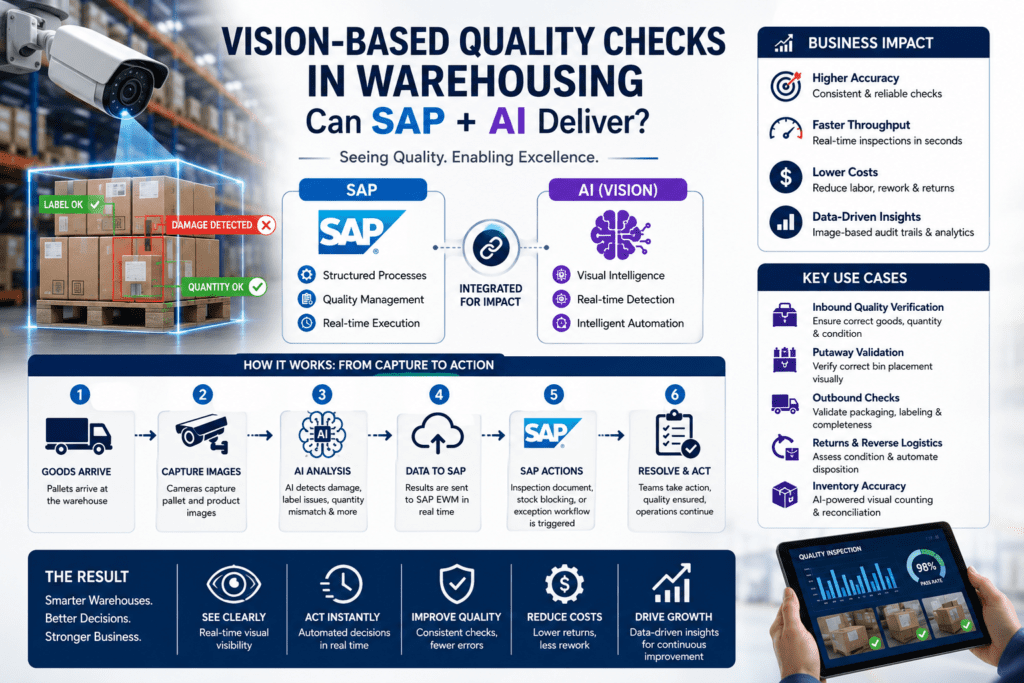
Vision-based quality inspection uses:
- Cameras (CCTV, mobile devices, smart scanners)
- AI models trained on images
- Real-time defect detection and classification
These systems can:
- Detect damage, dents, or packaging errors
- Verify labels, SKUs, and quantities visually
- Identify mismatches between physical goods and SAP records
AI-powered inspection platforms automate visual quality control with higher accuracy and speed, reducing human error and delays.
Bridging the Gap: SAP + Vision AI Integration
The real innovation lies not in AI alone—but in connecting AI outputs directly to SAP processes.
Platforms like AI vision solutions integrated with SAP:
- Convert images into structured SAP-ready data
- Trigger workflows automatically based on detected issues
- Enable real-time decision-making in warehouse operations
Key Use Cases in Warehousing
1. Inbound Quality Verification
Prevents incorrect stock entry and downstream issues
2. Automated Putaway Validation
• Ensure correct bin placement using visual confirmation
• Detect misplaced items instantly
3. Outbound Shipment Checks
• Validate packaging, labeling, and completeness before dispatch
• Reduce returns and customer complaints
4. Returns & Reverse Logistics
• Identify product condition and fraud during returns
• Automate grading (resell, repair, scrap)
5. Inventory Accuracy (Cycle Counting 2.0)
• Use cameras to visually count inventory
• Match with SAP stock in real time
Business Impact: Why It Matters
1. Accuracy at Scale
AI eliminates subjective human judgment:
- Consistent inspections
- Fewer errors
- Better compliance
2. Faster Throughput
Manual inspection slows down operations. Vision AI:
- Performs checks in seconds
- Enables faster goods movement
Some solutions report significant efficiency gains and faster identification cycles.
3. Cost Reduction
- Lower labor dependency
- Reduced rework and returns
- Minimized penalties from errors
4. Data-Driven Quality Intelligence
Every inspection becomes data:
- Image-based audit trails
- Root cause analysis
- Predictive quality insights
Challenges to Consider
Despite the promise, implementation isn’t plug-and-play.
Data Quality & Training
AI needs: High-quality labeled images Continuous learning
Gestion du changement
Warehouse teams must adapt: From manual checks → AI-assisted workflows
Integration Complexity
Aligning AI outputs with SAP master data Ensuring process consistency
Infrastructure Readiness
Camera placement Network latency Edge vs cloud processing
The Role of SAP BTP and AI Ecosystem
The real enabler behind this transformation is SAP Business Technology Platform.
It allows:
- Integration of AI models with SAP workflows
- Scalable processing of image data
- Real-time orchestration across systems
Solutions like PrimeS4 AI leverage this architecture to:
- Embed AI directly into SAP execution
- Provide decision support and automation
- Scale across multiple warehouse use cases
The Future: From Reactive to Autonomous Warehousing
Vision-based quality checks are the next natural evolution—bringing physical awareness into digital workflows.
With AI + SAP:
- Warehouses move from event-driven → predictive and autonomous systems
- Decisions are made before errors occur
AI already enables:
- Predictive replenishment
- Dynamic task optimization
- Real-time anomaly detection
Conclusion: Can SAP + AI Deliver?
Yes—but only together.
The combination of SAP and AI has the potential to truly transform warehouse quality management, but the real value emerges when both work together seamlessly. SAP brings a strong foundation with structured processes, a reliable transactional backbone, and an integrated quality management framework that ensures consistency and control across operations. On the other hand, AI introduces a new layer of capability through visual intelligence, real-time detection, and automation at scale, enabling systems to interpret and respond to physical conditions instantly. When these strengths are combined, warehouses move beyond simply recording events after they occur to actively seeing, analyzing, and acting in real time. This shift marks a significant evolution from reactive operations to intelligent, proactive decision-making ultimately driving higher efficiency, accuracy, and business value.
 English
  French
  Spanish
  Portuguese